Flowers for a Brand Activation: Behind the Scenes at an adidas Event in London
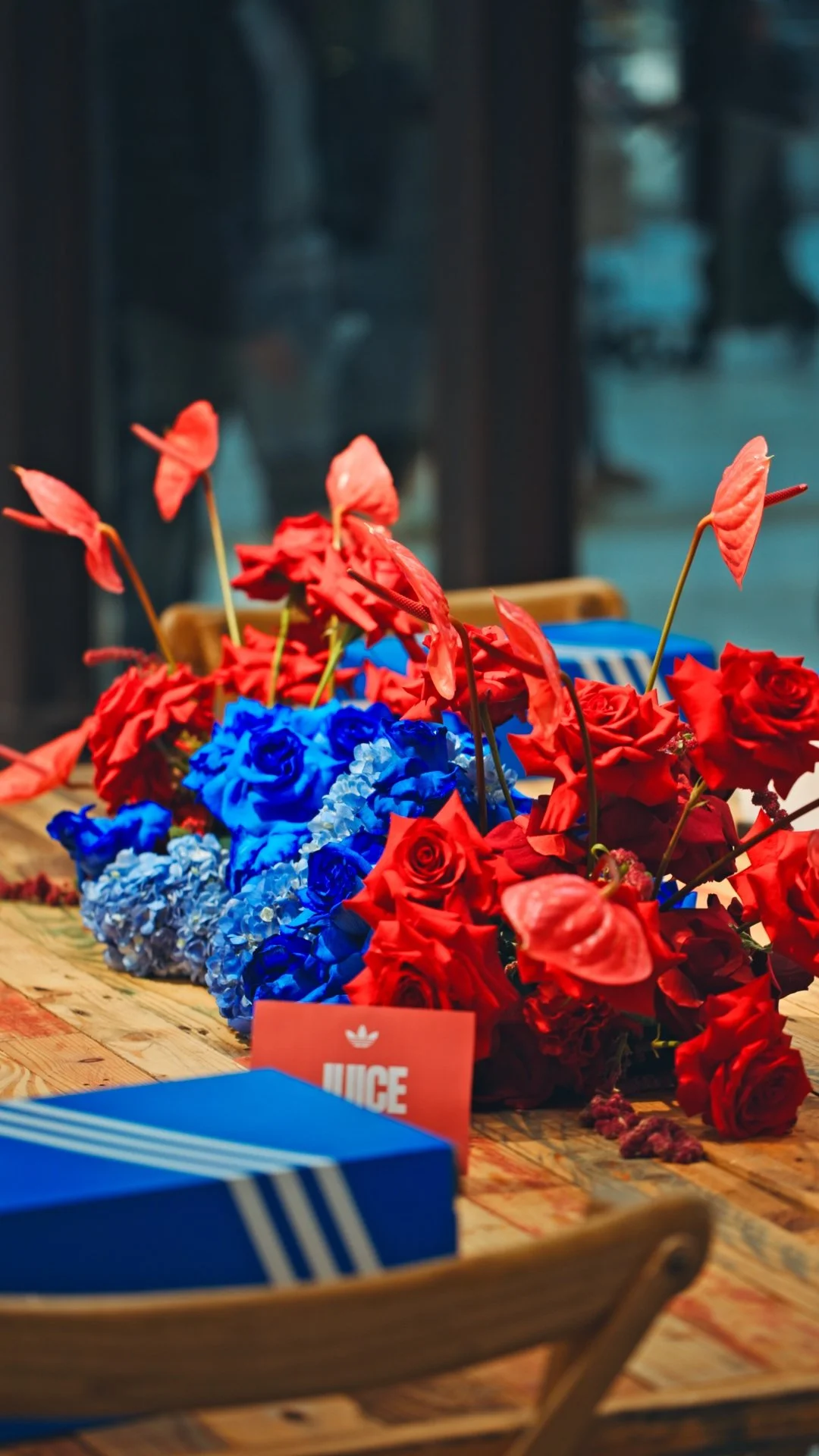
Red and blue silk flowers arranged for a fashion brand event
There is something very different about creating flowers for a brand activation compared with creating flowers for a private event. With a wedding or dinner, the starting point is often the person. You are designing around their personality, their preferences, the venue and the atmosphere they want to create. With a brand activation, there are usually several personalities in the room. There is the brand, there is the creative direction, there is the event planner, there is the production team, there are the guests, influencers, artists and creators. Then there is the audience online, because increasingly an event has to work just as well through a camera as it does in the room itself.
That was very much on my mind when I was commissioned by GUAP to provide the flowers for an adidas activation in London.
The event took place within one of adidas's flagship retail spaces and brought together guests, influencers and creatives for an experience centred around customising trainers. There was a DJ, music, movement and plenty happening throughout the space.
My job was to bring flowers into that environment while working with one of the strongest colour combinations you can be given as a florist…Red and blue to compliment one of their new releases. At first glance, it sounds straightforward, but it certainly was not.
The challenge of working with red and blue flowers
Red and blue are incredibly powerful colours individually. and together, they can be even more powerful.
The challenge is that when you are working with such recognisable colours, it is very easy for the flowers to become too literal. I did not want the result to feel like I had simply found some red flowers, added some blue flowers and put them into vases. That would have technically answered the brief, but it would not have answered the creative direction.
For a fashion and culture focused brand activation, the flowers needed to feel considered. They needed to photograph well, they needed to sit naturally within the retail environment, they needed to complement the adidas identity without trying to recreate the brand identity through flowers and most importantly, they needed to feel like part of the experience. This is something I always recommend to planners when they are considering floral design for a brand event.
Do not treat flowers as decoration that is added at the end. Think about them as part of the visual language of the activation, that distinction makes a huge difference. The strongest event florals do not necessarily shout the loudest. They support the environment, create visual rhythm and give guests something interesting to look at, photograph and interact with.
Why silk flowers made sense for this activation
One of the decisions I made for this project was to incorporate silk flowers. For some people, the words silk flowers immediately suggest something artificial or less luxurious, I think that perception is changing. When used properly, high quality artificial flowers can be an incredibly useful creative tool, particularly for brand activations, retail events, exhibitions, fashion events and influencer experiences. For this project, they gave me something that fresh flowers could not necessarily give me. Colour consistency.
When you are working with an extremely specific colour palette, you need to be able to control the visual result. Red is not simply red, there are deep reds, bright reds, burgundy reds, coral reds, berry reds and everything in between. The same applies to blue.
When a brand brief is built around a strong colour direction, the difference between a carefully selected shade and one that is slightly off can completely change the appearance of an installation. Silk flowers gave me the opportunity to be much more deliberate and they also offered practical advantages.
Brand activations can involve long production days, early installation times, lighting changes, busy retail environments and a lot of movement. Flowers may need to be installed well before guests arrive and remain looking consistent throughout the event. That is particularly important when photographers and content creators are involved. You do not want your hero floral moment looking beautiful at 4pm and tired by 9pm.
Designing for the camera as well as the room
This is something I think every florist working in experiential events should be thinking about. You are not just designing for the guest standing in front of the flowers, you are designing for the photograph that guest might take. You are designing for the video. You are designing for the background of a creator's Instagram Story. You are designing for the person who sees one photograph from the event three weeks later and wants to know who produced the installation.
This has become increasingly important as events are being designed with content capture in mind. Current experiential marketing thinking is moving towards what some industry specialists describe as creator friendly event design, hero moments and environments that can continue generating content after the physical event has finished.
That does not mean every floral arrangement needs to become an Instagram backdrop, it means you should understand where the camera is likely to be. For an activation like this, I am thinking about things such as:
Where will guests naturally stand?
Where will photographers be positioned?
What will appear behind people when they are photographed?
Will the flowers be visible from the entrance?
Will they add something to a wider shot of the space?
How will the colour look under the event lighting?
Will the flowers still have impact when they are surrounded by people, products, signage and movement?
These are not questions you necessarily ask when creating a vase of flowers for a private dinner. They become essential when working within experiential marketing.
Flowers need to work with the brand, not compete with it
One of the biggest mistakes I see when people approach event styling is thinking that every element needs to make a statement, but it doesn’t. There is already a lot happening at a brand activation. There may be branding, products, signage, furniture, lighting, music, entertainment, digital content and guests wearing their own very strong looks. The flowers have to understand their role within that ecosystem.
For the adidas activation, I wanted the red and blue flowers to contribute energy without becoming visually overwhelming. The palette was already bold, so I could allow the colour to do some of the work. I focused more on shape, texture, density and placement. That is often how I approach difficult colour briefs. If the colour is strong, you do not necessarily need to make every other element equally loud. Sometimes the sophistication comes from restraint.
What event planners should consider when commissioning a florist
If you are an event planner, producer, creative agency or brand looking for a florist for an activation, there are a few things I would recommend including in the brief.
1. Explain the purpose of the flowers
Are they there to create an entrance moment?
Are they dressing a product display?
Are they creating a photo opportunity?
Are they being used as table styling?
Are they part of a larger installation?
Are they helping soften a retail environment?
The more clearly I understand the purpose, the better I can design. A florist should not just be told, "We need some flowers." Tell them what you need the flowers to achieve.
2. Share the wider creative direction
If there is a moodboard, send it.
If there is a campaign image, send it.
If there is a brand guideline, send it.
If the event is connected to a product launch or cultural campaign, explain that context.
Flowers look very different when they are considered in isolation compared with when they are considered alongside the wider creative direction.
3. Be honest about the colour palette
If you need a very specific red, say so.
If the brand has a particular shade of blue, share the reference.
If there are colours that cannot appear, mention those too.
This allows the florist to make decisions early rather than trying to correct the palette once everything has been ordered.
4. Think about installation
This is especially important for London events.
Where is the venue?
What time can we load in?
Is there a lift?
Is there parking?
How far is the unloading point from the event space?
Is there security?
Does the florist need to provide installation and collection?
Can flowers be attached to anything?
Are there restrictions on water?
These practical details can completely change the floral approach. A good event florist is not only thinking creatively, they are thinking logistically.
Why experiential events require a different type of florist
If you are a planner working on a brand activation, you are probably not simply looking for someone who can make a beautiful bouquet, you are looking for someone who understands production. You need someone who can take a creative brief and turn it into something physical.
Someone who can work alongside an event production team, someone who understands timings, Someone who can arrive prepared, someone who can make decisions quickly when something changes, someone who understands that the flowers are one part of a much larger production.
This is particularly relevant for experiential marketing because the events themselves are becoming more strategically important to brands. EventTrack 2026 reports that brands are increasingly treating live experiences as a central part of the marketing mix, with experience, impact and measurable outcomes becoming more important considerations.
That makes the suppliers involved in those experiences more important too. The florist is not simply filling a decorative gap, they are contributing to the brand experience.
Working with agencies, planners and creative teams
I enjoy working on projects where there is already a strong creative team involved. There is something exciting about receiving a brief and figuring out how flowers can interpret it. For agencies, this can also make the process much easier. You do not necessarily need to know exactly what flowers you want, you need to know what you want people to feel. You might say:
"We want it to feel energetic."
"We want it to feel youthful."
"We want something bold."
"We need it to photograph well."
"We need flowers that can survive a full event day."
"We need something that feels fashion led."
"We have a very strict colour palette."
Those are all useful starting points. From there, my role is to translate the idea into floral design. That is why I see my work as much more than supplying flowers, it is about solving a visual problem.
Red and blue taught me something important
This project reminded me that the most interesting briefs are not always the easiest ones. A brief that says, "Use beautiful flowers in whatever colours you like" gives you enormous creative freedom. A brief that says, "Here are two very strong colours. Make this work within a fashion focused brand environment" gives you a problem to solve and I like those problems.
The red and blue palette pushed me to think beyond conventional fresh flower combinations and consider the wider visual effect. It encouraged me to think about artificial flowers as a legitimate creative resource rather than simply a substitute for fresh flowers. It also reinforced the importance of designing for the environment.
The flowers needed to make sense inside a flagship retail space, they needed to work alongside adidas products. They needed to sit comfortably within an event attended by influencers and creatives and they needed to look good when photographed. That is the difference between simply supplying flowers and creating floral styling for a brand experience.
Why flowers still have a place in highly produced events
With so much technology now available for experiential marketing, it can be tempting to assume that every activation needs something digital, interactive or technologically impressive. But physical details still matter, flowers are tactile. They bring softness into commercial spaces, they introduce colour, they create texture and they can make a temporary environment feel more considered. They also photograph incredibly well and there is something interesting about placing something organic or floral within a highly designed retail environment.
In a world where brands are increasingly trying to create more memorable and emotionally resonant experiences, physical details can help make a space feel human. Current 2026 experiential trends also point towards richer sensory experiences, personalisation and authenticity rather than relying purely on spectacle. For me, that is where floral design becomes particularly interesting. It does not have to be the centre of attention, it just needs to be the right detail in the right place.
Looking for a London florist for your next brand activation?
If you are an event planner, experiential agency, PR agency, creative agency, fashion brand, influencer agency or production company working on an upcoming event in London, floral styling can be a surprisingly effective way to bring a creative direction into the physical space.
Whether you are planning a product launch, influencer event, press event, fashion event, retail activation, private brand experience or corporate event, I can work from your existing creative direction or help develop the floral concept from the beginning.
The adidas activation was a great example of how a relatively simple brief can become an interesting creative challenge. Red and blue, a flagship retail environment, influencers and guests, customised trainers, music, movement, content and flowers that needed to belong within all of it.
That is the part of event floristry I enjoy most. Taking the brief, understanding the environment and finding a floral solution that feels like it was always meant to be there.
If you are planning a brand activation in London and need a floral designer who understands both the creative and practical side of event production, I would love to hear about your next project.